
Context & scale
How Galveston Compares
Galveston faces one of the most severe storm surge threats on the Gulf Coast — yet neighboring communities have already built the barriers that protect them.
WHY THIS COMPARISON MATTERS
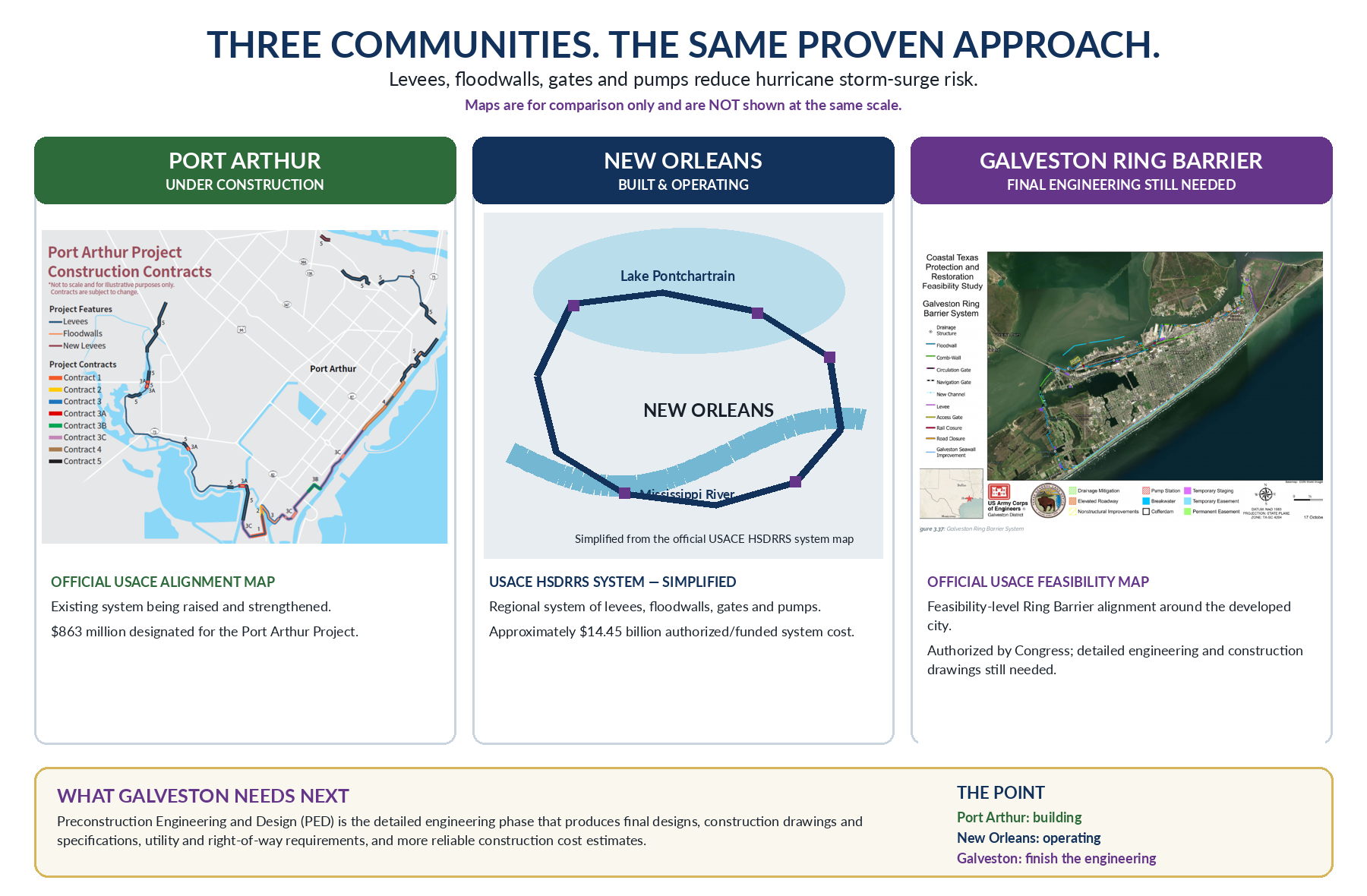
Port Arthur, New Orleans and Galveston face the same fundamental threat: hurricane storm surge. The basic engineering solutions are well established — levees, floodwalls, gates and pumping systems.
Port Arthur is already under construction. New Orleans has a completed protection system that is operating today. Galveston's Ring Barrier has completed feasibility planning and has been authorized by Congress, but the detailed engineering and construction design needed to build it have not yet been completed.
WHAT GALVESTON NEEDS NEXT
The next step is Preconstruction Engineering and Design (PED). This is the detailed engineering phase that produces the final designs, construction drawings and specifications, identifies utility and right-of-way requirements, and develops more reliable construction cost estimates.
Galveston does not have to find billions of dollars to build the entire Ring Barrier in order to get started.
The immediate objective should be to fund and accelerate this detailed engineering work so the Ring Barrier can become construction-ready.
WHY WAIT?
Major coastal protection work is already moving forward elsewhere on the Texas coast. Port Arthur demonstrates that these proven systems can be designed, funded and constructed.
Galveston should move its Ring Barrier forward now — completing the engineering needed so that when major federal and state construction funding becomes available, Galveston is ready.
Don't wait for the next hurricane. Design it. Fund it. Build it.
Three Cities. Three Levels of Protection.
When Hurricane Ike struck in 2008, it exposed a stark reality: Galveston and the surrounding Houston Ship Channel region had no storm surge barrier — while other Gulf Coast cities had already invested in protecting their residents and economies.
Port Arthur, Texas and New Orleans, Louisiana both have federally funded surge protection systems in place. Galveston's proposed Ring Barrier would provide comparable — and in some respects superior — protection for one of the most economically vital coastal regions in the United States.
Port Arthur, Texas
Port Arthur received federal funding for a storm surge barrier system following Hurricane Harvey in 2017. The project, backed by the U.S. Army Corps of Engineers, provides protection for the city and its critical industrial infrastructure along the Sabine-Neches Waterway.
Port Arthur's barrier demonstrates that federal investment in Gulf Coast surge protection is achievable — and that communities that advocate persistently can secure the funding and construction they need.
New Orleans, Louisiana
Following the catastrophic failure of flood protection during Hurricane Katrina in 2005, New Orleans received over $14 billion in federal investment to build the Hurricane and Storm Damage Risk Reduction System (HSDRRS) — a network of levees, floodwalls, and surge barriers that now encircles the greater New Orleans area.
The Lake Borgne Surge Barrier, completed in 2013, is the largest surge barrier in the United States. New Orleans' experience shows what is possible when federal will and local advocacy align — and what is at stake when they do not.
The Galveston Ring Barrier
The Galveston Ring Barrier — the centerpiece of the U.S. Army Corps of Engineers' Coastal Texas Protection and Restoration Study — would protect Galveston Island, the Bolivar Peninsula, and the Houston Ship Channel from storm surges of up to 21 feet.
The Houston Ship Channel handles roughly 67% of the nation's petrochemical production. A major storm surge event without a barrier in place could cause economic damage far exceeding the cost of construction — damage that would ripple across the entire U.S. economy.
The Ring Barrier has received congressional authorization. What it needs now is full federal funding and the sustained public and political will to see it built.
Galveston Deserves the Same Protection
Port Arthur has it. New Orleans has it. The technology is proven, the federal authorization is in place, and the need is undeniable. The question is not whether Galveston can be protected — it is whether we will demand that it be.